Friday, September 24, 2010

the struggle for recognition

Chokgyur Lingpa
Chokgyur Lingpa's early treasure revelations are recorded in multiple ambiguous and confused narratives. He himself wrote that before his thirteenth birthday he was visited by a vision of Padmasambhava, and that this was followed by “many unwanted and confusing apparitions,” some of them reportedly unintelligible, others apparently clear signs that he would reveal treasure. After he announced publicly that he would extract treasure from Namkadzod, one of his early teachers, Ngedzin Pusiri (gnas 'dzin pu si ri) at Pelme monastery, specifically forbade him from doing so. Nevertheless, the first four of his treasure revelations date to this period, including one of his most successful, the Barche Kunsel(bar chad kun sel), said to have been revealed in October 1848 from Danyin Kala Rongo (zla nyin kha la rong sgo), when Chokgyur Lingpa was only nineteen years old.

Biographies of Chokgyur Lingpa report that his colleagues in Nangchen scorned him, rejecting his claims to be a treasure revealer, and in his autobiography he expresses considerable frustration at this inability to gain acceptance. The nickname by which he was known during this period, Kyasu Terton (skya su gter ston), might be rendered in English as “the so-called treasure revealer of the Kyasu clan.” Ultimately, when he was twenty-five Chokgyur Lingpa left Nangchen for Derge, in search of patrons who might legitimize his treasure-revealing status. The biographies have it that Chokgyur Lingpa was expelled from his monastery, ostensibly for making mistakes during a ritual dance. But if he was in fact expelled, it is likely that it was due to his assertions that he was a treasure revealer, which possibly included his having taken a consort. Although this is nowhere explicit in the biographies, there is sufficient reason to believe that Chokgyur Lingpa began his relationship with his main consort, Dekyi Chodron (bde skyid chos sgron), before he left Nangchen in 1853.

read full biography at The Treasure of Lives

more info on image at Himalayan Art

Friday, September 03, 2010

Chokgyur Lingpa


Click on image to see large
For more on this image go here
(h/t to anon-linker)

Wednesday, September 01, 2010

Adeu Rinpoche


A video highlighting Adeu Rinpoche apparently at the enthronement of a young tulku, if anyone knows details of who it is (I assume that is their footprint in the rock) please let us know.

Saturday, August 07, 2010

Towards a Buddhist Ecology

We talk a lot about protecting and safeguarding the environment, about the importance of organic foods, and so on. The point, however, is not just to talk about it, but to make sure that we actually do take care of our environment. What we do will have very far reaching consequences, affecting even the most subtle forms of life on this planet. We need to prevent future disaster, and to do that we must first of all seek to understand what direction we are moving in. We must try to identify where things have gone wrong and discuss how we can best restore and improve wherever there are problems. In this way, we way we can make sure that the future is a happy one. If the outer environment is healthy and in balance, the physical well-being of all who inhabit it can also improve, and this, in turn, allows for peace of mind, kind heartedness, and brightness of the mind. In short, we can come to experience true joy and fulfilment.
On the other hand, what prevents this is, basically, human craving and selfishness: Having no concern for what may happen later; simply thinking that the elements are there to be exploited; for me to become as rich as possible - even if it means poisoning the world -- that type of selfish attitude. So what we think and do matters. (read more)
Chökyi Nyima Rinpoche

Saturday, July 24, 2010

Provocative film about the human's life and nourishment


http://veg-tv.info/Earthlings

Why would the issue or eating or not meat come up on this page?

Compassion and insight are the core values on the Buddha's path to enlightenment.

Here is a film about insight into how we live and feed made in a very compassionate way.

Jigme Khyentse Rinpoche suggested to watch it 100 times.


"This meat and not to eat, that is the answer."

Friday, July 09, 2010

from Erik Pema Kunsang

Hello friends of the Gomde centers, students of Tulku Urgyen Rinpoche and Chokyi Nyima Rinpoche, Tsikey Chokling Rinpoche and Phakchok Rinpoche, and you who have visited the Monastery in Nepal.

I have a query-question: do you have a small study or meditation group where you meet regularly, like minimum 8 people? Or are you interested in forming one? Chokyi Nyima Rinpoche would like to help you with Dharma materials in video/audio format.

Write to me and tell where you are in the world.

Warmest wishes from Erik
rangjung@gmail.com

Saturday, July 03, 2010

Dilgo Khyentse Yangsi Rinpoche - Free Video Streaming

18 July 2010, 3pm Paris time (GMT+2)

Join the video streaming here: http://videostreaming.rigpa.org/

The streaming of this exciting event is offered for free. If you would like to support it, you are welcome to make a donation on the website.

Friday, July 02, 2010

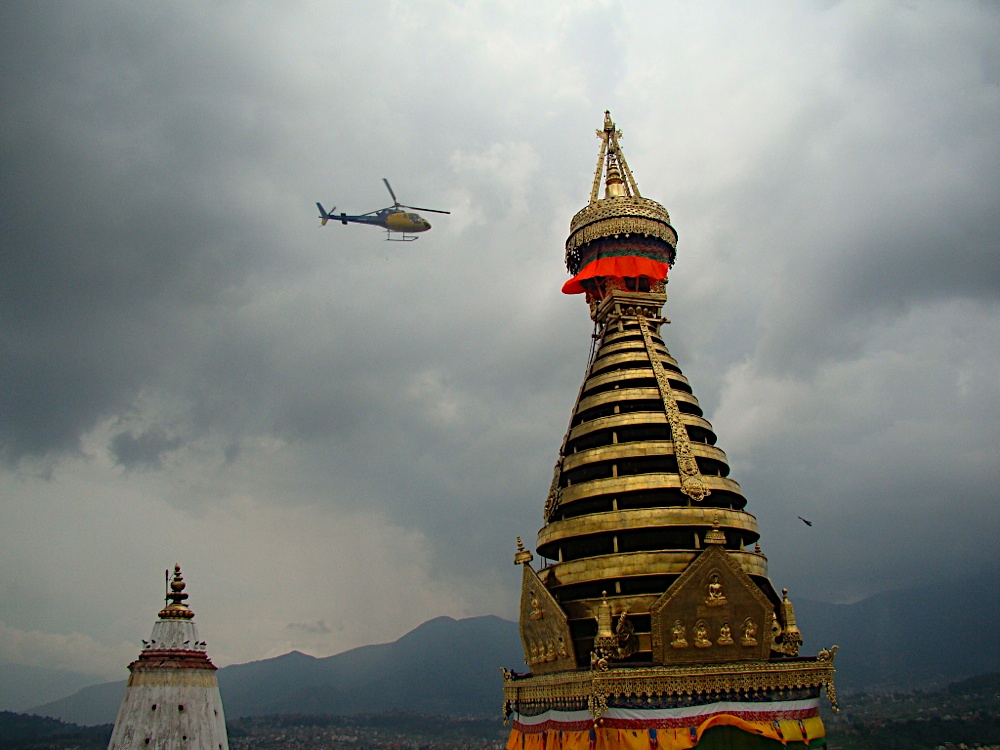
Restoration of Swayambhu Stupa


We are happy to share with you some photos (view slideshow) from some recent events held at Swayambhu: A May 27th National Peace and Unity Event and a three-day consecration Tibetan Puja, performed from the sky by His Holiness Trulshik Rinpoche. For the next couple of weeks we will continue with elaborate Vajrayana re-consecration pujas at Swayambhu performed by Newari priests from around the Kathmandu Valley.

Started in July 2008, the Renovation of Swayambhu was completed during the most auspicious month of Saga Dawa in May 2010. Involving many of the finest artisans in Nepal from Gold, Copper, Iron, and Wood traditions, the renovation involved the removal, repair and re-gilding of the vajra, mandala, nine shrines, harmika, spire, and cornice. To celebrate the completion of the work on the Stupa, a large peace and unity event was held on May 27th, 2010 - Buddha Jayanti.

Hundreds of thousands of people were invited to light a lamp for peace and unity in Nepal and the world. Thousands came to Swayambhu to light a lamp while other lit a lamp and observed a moment of silence at home or in their communities around the country and world. The entire event was live telecast. That evening, 13,000+ bags of sand supporting candles were placed around the Stupa, down the stairways, and along the main circumambulatory path. At 7:30 pm at Swayambhu Stupa, an official lamp lighting ceremony began with the ringing of bells, followed by a minute of silence. Then an old man and young man and lit a large butter-lamp, symbolizing the coming together of different generations to achieve peace and unity. Once the lamp was lit, a chorus of famous singers from Nepal sang a song of peace and the Stupa was lit up from all four sides. For hours people circumambulated the Stupa lighting lamps and enjoying the beautiful scene of the Stupa, bright and shining, on top of the heart of the Kathmandu Valley.

Tuesday, June 15, 2010

Gebchak meets Google


Wangdrak Rinpoche of Gebchak Gompa, and Caterina De Re give a presentation about the Gebchak Nunnery at Google's headquarters in San Francisco.

Monday, May 17, 2010

Wonderful liberation through seeing and reading


The writing is by the precious master Dudjom Jigdral Yeshe Dorje - Mara-Tamer Fearless Wisdom Vajra, who is mentioned with deep veneration by Tulku Urgyen in Blazing Splendor.

Photo from Rinchen Lhamo.

Sunday, May 16, 2010

Bringing Buddhism to the West

A conversation with Jamgon Kongtrul Rinpoche October 1988

Question: The question always seems to come back to the same thing, which is how an ancient tradition, which grew up in a certain cultural environment and comes from a background entirely different from our modern world can come into the modern world, with all the forces at work here that are so different from—and even against—the spiritual search. What adjustments need to be made and how do you see the particular problem of modern people? Modern civilization with its technology and economic situation has created an entirely different atmosphere than the tradition that you grew up in. What do you see as the specific first steps that need to be taken for us, for modern people?

Answer: It is very true that the whole of our world is becoming modernized. However, we have also to understand that Buddhism first developed in India and adapted itself to the cultural tradition there. And later, when Buddhism was brought into Tibet from India, it also had to adapt itself to the Tibetan tradition. But the essential Buddhist teaching has remained very much unchanged. The essential quality of Buddhism and the meditation practices never really changed in going from one country to another.

So, therefore, Buddhism emphasizes two aspects of the teaching: the “view” aspect, and the “practice” or “meditational” aspect. The “view” aspect of Buddhism teaches the ultimate nature of outer phenomena and the ultimate nature of ourselves. That ultimate nature never changes, whether considering ancient times, a thousand years ago, or the modern era. So Buddhism speaks philosophically about the ultimate nature of external and internal being, and about that ultimate nature remaining unchanged.

Therefore, what is made available to the new generation of the Western world is that very essential, or ultimate, part of Buddhism, which is called the Dharma. And again, speaking from experience, if the Dharma were false or if the new practitioners in the West had to adopt a Buddhism which included the Tibetan culture, then it would become conflicting and could create considerable misunderstanding and confusion in the minds of the beginning practitioners. This has been the case since ancient tunes.

So what seems proper is for the Western mind to adopt the essential nature of Buddhism, the Dharma, and not necessarily the cultural aspects. And it seems important for all of us to maintain a responsibility not to mix the Dharma with a culture or tradition.

One must not look at the Dharma as belonging to somebody or some nation; if one does so, this can be the beginning of the greatest confusion. So Rinpoche believes that the Dharma can be adapted to any culture, but one cannot make the Dharma into a culture.

read more

Friday, May 14, 2010

Tulku Urgyen Rinpoche Teaching


Tulku Urgyen Rinpoche teaching. The translator is Erik Pema Kunsang. Chokyi Nyima Rinpoche sits behind Erik.

Friday, April 23, 2010

Benefits of reciting the Vajra Guru Mantra


The Vajra Guru Mantra is the mantra associated with Guru Rinpoche, also known as Padmasambhava. This is a draft translation of a treasure text which explains the Vajra Guru Mantra. It was originally concealed during the time of Padmasambhava in Tibet and later rediscovered by Karma Lingpa (14th century) who brought it forth from its place of concealment and copied it down on reams of gold. It is simply known as "The Syllable by Syllable Commentary Explaining the Benefits of the Vajra Guru Mantra." It begins with an invocation and then goes into a dialogue between Yeshe Tsogyal, the spiritual consort of Padmasambhava, and Padmasambhava himself.

Here is the full text >>click<<

Tuesday, April 20, 2010

Devastating earthquake around Yushu

Please consider donating generously to the efforts of supporting the people of Nangchen who lost family members and their dwellings, and to rebuild the monasteries that are so important in their lives. Many of the lamas and Rinpoches mentioned in Blazing Splendor come from this area and will spearhead these efforts.

You are welcome to post the links to them here as comments.

Thursday, April 15, 2010

News of Adeu Rinpoche's reincarnation


A moving and personal account from Choegon Rinpoche of Dechen Chokhor Ling. Click >>here<<.