Hello friends of the Gomde centers, students of Tulku Urgyen Rinpoche and Chokyi Nyima Rinpoche, Tsikey Chokling Rinpoche and Phakchok Rinpoche, and you who have visited the Monastery in Nepal.
I have a query-question: do you have a small study or meditation group where you meet regularly, like minimum 8 people? Or are you interested in forming one? Chokyi Nyima Rinpoche would like to help you with Dharma materials in video/audio format.
Write to me and tell where you are in the world.
Warmest wishes from Erik
rangjung@gmail.com
Friday, July 09, 2010


Saturday, July 03, 2010
Dilgo Khyentse Yangsi Rinpoche - Free Video Streaming
18 July 2010, 3pm Paris time (GMT+2)
Join the video streaming here: http://videostreaming.rigpa.org/
The streaming of this exciting event is offered for free. If you would like to support it, you are welcome to make a donation on the website.
Join the video streaming here: http://videostreaming.rigpa.org/
The streaming of this exciting event is offered for free. If you would like to support it, you are welcome to make a donation on the website.
Friday, July 02, 2010
Restoration of Swayambhu Stupa
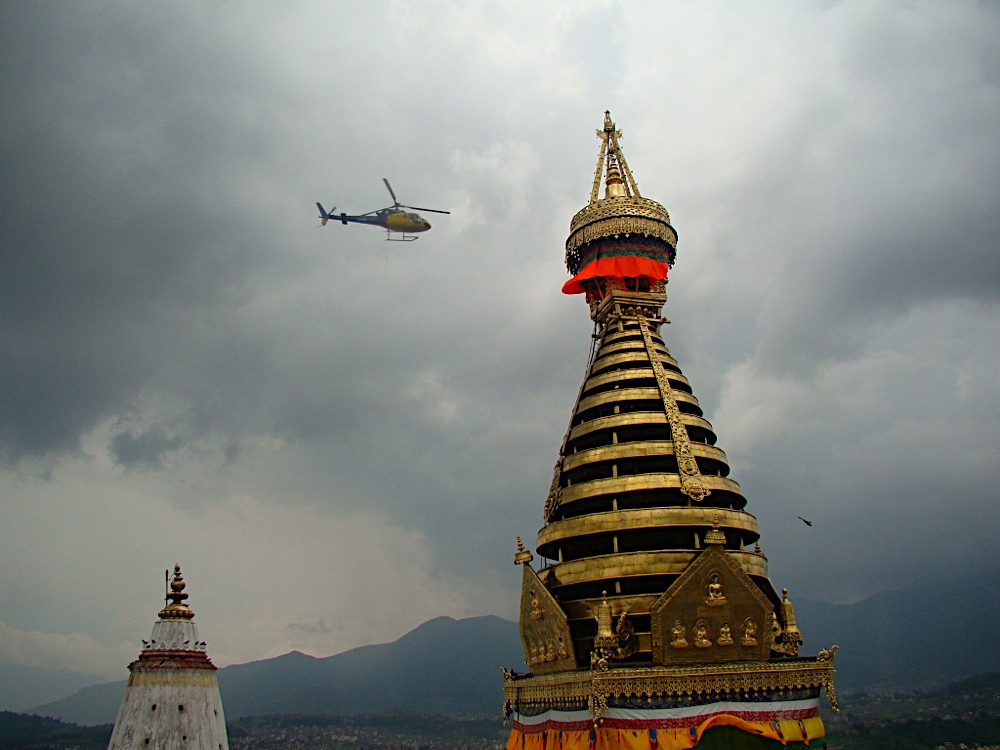
We are happy to share with you some photos (view slideshow) from some recent events held at Swayambhu: A May 27th National Peace and Unity Event and a three-day consecration Tibetan Puja, performed from the sky by His Holiness Trulshik Rinpoche. For the next couple of weeks we will continue with elaborate Vajrayana re-consecration pujas at Swayambhu performed by Newari priests from around the Kathmandu Valley.
Started in July 2008, the Renovation of Swayambhu was completed during the most auspicious month of Saga Dawa in May 2010. Involving many of the finest artisans in Nepal from Gold, Copper, Iron, and Wood traditions, the renovation involved the removal, repair and re-gilding of the vajra, mandala, nine shrines, harmika, spire, and cornice. To celebrate the completion of the work on the Stupa, a large peace and unity event was held on May 27th, 2010 - Buddha Jayanti.
Hundreds of thousands of people were invited to light a lamp for peace and unity in Nepal and the world. Thousands came to Swayambhu to light a lamp while other lit a lamp and observed a moment of silence at home or in their communities around the country and world. The entire event was live telecast. That evening, 13,000+ bags of sand supporting candles were placed around the Stupa, down the stairways, and along the main circumambulatory path. At 7:30 pm at Swayambhu Stupa, an official lamp lighting ceremony began with the ringing of bells, followed by a minute of silence. Then an old man and young man and lit a large butter-lamp, symbolizing the coming together of different generations to achieve peace and unity. Once the lamp was lit, a chorus of famous singers from Nepal sang a song of peace and the Stupa was lit up from all four sides. For hours people circumambulated the Stupa lighting lamps and enjoying the beautiful scene of the Stupa, bright and shining, on top of the heart of the Kathmandu Valley.
Tuesday, June 15, 2010
Gebchak meets Google
Wangdrak Rinpoche of Gebchak Gompa, and Caterina De Re give a presentation about the Gebchak Nunnery at Google's headquarters in San Francisco.
Saturday, May 22, 2010
Monday, May 17, 2010
Wonderful liberation through seeing and reading

The writing is by the precious master Dudjom Jigdral Yeshe Dorje - Mara-Tamer Fearless Wisdom Vajra, who is mentioned with deep veneration by Tulku Urgyen in Blazing Splendor.
Photo from Rinchen Lhamo.
Sunday, May 16, 2010
Bringing Buddhism to the West
A conversation with Jamgon Kongtrul Rinpoche October 1988
Question: The question always seems to come back to the same thing, which is how an ancient tradition, which grew up in a certain cultural environment and comes from a background entirely different from our modern world can come into the modern world, with all the forces at work here that are so different from—and even against—the spiritual search. What adjustments need to be made and how do you see the particular problem of modern people? Modern civilization with its technology and economic situation has created an entirely different atmosphere than the tradition that you grew up in. What do you see as the specific first steps that need to be taken for us, for modern people?
Answer: It is very true that the whole of our world is becoming modernized. However, we have also to understand that Buddhism first developed in India and adapted itself to the cultural tradition there. And later, when Buddhism was brought into Tibet from India, it also had to adapt itself to the Tibetan tradition. But the essential Buddhist teaching has remained very much unchanged. The essential quality of Buddhism and the meditation practices never really changed in going from one country to another.
So, therefore, Buddhism emphasizes two aspects of the teaching: the “view” aspect, and the “practice” or “meditational” aspect. The “view” aspect of Buddhism teaches the ultimate nature of outer phenomena and the ultimate nature of ourselves. That ultimate nature never changes, whether considering ancient times, a thousand years ago, or the modern era. So Buddhism speaks philosophically about the ultimate nature of external and internal being, and about that ultimate nature remaining unchanged.
Therefore, what is made available to the new generation of the Western world is that very essential, or ultimate, part of Buddhism, which is called the Dharma. And again, speaking from experience, if the Dharma were false or if the new practitioners in the West had to adopt a Buddhism which included the Tibetan culture, then it would become conflicting and could create considerable misunderstanding and confusion in the minds of the beginning practitioners. This has been the case since ancient tunes.
So what seems proper is for the Western mind to adopt the essential nature of Buddhism, the Dharma, and not necessarily the cultural aspects. And it seems important for all of us to maintain a responsibility not to mix the Dharma with a culture or tradition.
One must not look at the Dharma as belonging to somebody or some nation; if one does so, this can be the beginning of the greatest confusion. So Rinpoche believes that the Dharma can be adapted to any culture, but one cannot make the Dharma into a culture.
read more
Friday, May 14, 2010
Tulku Urgyen Rinpoche Teaching
Tulku Urgyen Rinpoche teaching. The translator is Erik Pema Kunsang. Chokyi Nyima Rinpoche sits behind Erik.
Monday, May 10, 2010
Friday, April 23, 2010
Benefits of reciting the Vajra Guru Mantra

The Vajra Guru Mantra is the mantra associated with Guru Rinpoche, also known as Padmasambhava. This is a draft translation of a treasure text which explains the Vajra Guru Mantra. It was originally concealed during the time of Padmasambhava in Tibet and later rediscovered by Karma Lingpa (14th century) who brought it forth from its place of concealment and copied it down on reams of gold. It is simply known as "The Syllable by Syllable Commentary Explaining the Benefits of the Vajra Guru Mantra." It begins with an invocation and then goes into a dialogue between Yeshe Tsogyal, the spiritual consort of Padmasambhava, and Padmasambhava himself.
Here is the full text >>click<<
Tuesday, April 20, 2010
Devastating earthquake around Yushu
Please consider donating generously to the efforts of supporting the people of Nangchen who lost family members and their dwellings, and to rebuild the monasteries that are so important in their lives. Many of the lamas and Rinpoches mentioned in Blazing Splendor come from this area and will spearhead these efforts.
You are welcome to post the links to them here as comments.
You are welcome to post the links to them here as comments.
Thursday, April 15, 2010

Wednesday, April 07, 2010
Kela Chokling has passed on.


It is with great sadness we inform you that the Kela Chokling incarnation has left his body. After the strict suppression of Buddhist practice eased off in the '80, Kela Chokling worked tirelessly to restore one of the three main "seats" of the great treasure revealer Chokgyur Lingpa. He also was able to transmit the entire collection of Chokling Tersar teachings on many tulku, lamas, monks, nuns, and laypeople, which he has received primarily for the Tsikey Chokling and Tulku Urgyen in Nepal.
Among the tulkus present were his sons and lineage holders as well as Trungpa Tulku and Rolpey Dorje of the Surmang lineage.
Monday, April 05, 2010
Two great masters of the 20th century

Dzongsar Jamyang Khyentse Chokyi Lodro together with one of his chief disciples, Dilgo Khyentse Rabsel Dawa.
Monday, March 22, 2010
Rare footage of Dilgo Khyentse and Tulku Urgyen together
This video contains wonderful footage of Tulku Urgyen visiting Dilgo Khyentse Rinpoche for the last time. Lots of familiar faces including Tulku Urgyen's sons Chokyi Nyima Rp. and Tsoknyi Rp., as well as his close disciple Andreas Kretschmar. Footage begins around the 2:30 mark.
Our thanks to the anonymous person who shared the link.
Thursday, March 11, 2010
Crystal Lotus Cave
A special thanks to Michael and Helen for sharing these photos of their pilgrimage to Pema Shelpuk.

Tangton Gyalpo Iron bridge

on the way to Pema Shelpuk (Crystal Lotus Cave)


view of terma site


entrance to the cave where the Dzogchen Desum was revealed

caretakers of the cave

altar inside the cave

statue of Padmasambhava

retreat huts offered free to those doing retreat or kora

Saturday, March 06, 2010
Two precious reincarnations
The two reincarnations of Dilgo Khyentse Rinpoche and Tulku Urgyen Rinpoche - seated together at Shechen Monastery in Boudhanath, Nepal.
Sunday, January 03, 2010
Khandro Rinpoche on pilgrimage
Khandro Rinpoche explained at Karma Shedrup Ling, Norway in 2007 why it is beneficial to do Buddhist pilgrimages.
Thursday, December 17, 2009
A new Three-year retreat begins

Due to Tulku Urgyen Rinpoche's constant endeavor, a large temple structure was built around the Asura Cave of Padmasambhava. It is now continued and has been enlarged by Chokyi Nyima Rinpoche. Many groups of monks and many other people have since then been in the traditional three year retreat at this sacred location. Here you see one such group about to enter.
Thursday, December 10, 2009
Lotus Outreach

Don't miss this rare opportunity to bid on priceless original works of art by Lotus Outreach Chairman and Founder, Khyentse Norbu! 100% of proceeds from this exclusive 10-day auction will benefit the women and children served by Lotus Outreach in India and Cambodia. Adorn your home and support the cause. Place your bid now at http://shop.ebay.com/lotus_outreach/m.html?_nkw=&_armrs=1&_from=&_ipg=25!
More details here.
Subscribe to:
Posts (Atom)

