Tuesday, April 25, 2006

New head of Lachab Monastery


Just before leaving for Singapore, Chokyi Nyima Rinpoche handed me a letter to translate. It had been written by Ngaktrin Tulku last year, prior to his passing. The letter appoints Karma Gyaltsen Rinpoche to be incharge of the monasteries and retreat centers.

An announcement to all sublime upholders of the Dharma and faithful male and female practitioners and laypeople, especially the main lamas of area:
Karma Gyaltsen Rinpoche—who stems from a line of siddhas, the Tsangsar clan of Nangchen, and who is educated, disciplined and noble-minded, and is experienced and realized—has the qualifications for being responsible for the teachings and the monasteries. Accordingly, I have enthroned him has my successor in the position of crown ornament of Buddhadharma for Tsangsar Lachab Gompa, both the main and the branch monasteries.
It is therefore my hope and request that all sublime masters and faithful benefactors extend him their continued trust and assistance with joy and perseverance. Together with my fervent prayers to the Three Jewels who are the source of benefit and happiness for all beings and for the Buddha's teachings, this was written by Ngaktrin Tulku on the fifteenth day of the tenth month in year of the Female Wood Bird (2005).

Thursday, April 20, 2006

Shri Singha

Sorry not much of interest has been happening here for the past couple of weeks but Erik has been up in retreat at Nagi Gompa. Here's a rather gorgeous picture of Shri Singha, to help tie you over until Erik returns and starts to share his photo collection with everyone once again.

Shri Singha was the chief disciple and successor of Manjushrimitra in the lineage of the Dzogchen teachings. He was born in the Chinese city of Shokyam in Khotan and studied at first with the Chinese masters Hatibhala and Bhelakirti. In his Ocean of Wondrous Sayings, Guru Tashi Tobgyal adds that Shri Singha received a prophesy from Avalokiteshvara while traveling to Serling, telling him to go to the Sosaling charnel ground in order to be sure of the ultimate attainment. After many years Shri Singha met Manjushrimitra in the charnel ground of Sosaling, and remained with him for twenty-five years. Having transmitted all the oral instructions, the great master Manjushrimitra dissolved his bodily form into a mass of light. When Shri Singha cried out in despair and uttered songs of deep yearning, Manjushrimitra appeared again and bestowed him a tiny casket of precious substance. The casket contained his master's final words, a vital instruction named Gomnyam Drugpa, the Six Experiences of Meditation. Having received this transmission, Shri Singha reached ultimate confidence. In Bodhgaya he found the manuscripts of the tantras previously hidden by Manjushrimitra which he took to China where he classified the Instruction Section (man ngag sde) into four parts: the outer, inner, secret, and the innermost unexcelled sections. Among Shri Singha's disciples were four outstanding masters: Jnanasutra, Vimalamitra, Padmasambhava and the Tibetan translator Vairotsana.

Saturday, April 08, 2006

Review from Shambhala Sun

Tulku Urgyen was a renowned Buddhist teacher who held the highest teachings of two Tibetan lineages and spent more than twenty years in retreat. He was also fundamentally self-effacing, so while there were many extraordinary experiences in his own life that he could have shared before he died in 1996, these memoirs—told to Erik Pema Kunsang, Tulku Urgyen’s longtime translator, and his wife Marcia Schmidt—consist largely of stories of other great twentieth-century Tibetan teachers. Some of the stories are fantastic (for example, miracles of healing and clairvoyance and the recovery of sacred texts, terma, hidden for a thousand years). Many more are compelling for their intimate portraits of some of the great masters of the twentieth century, and because they reveal the inner workings of an intact religious system in pre-1959 Tibet. Blazing Splendor puts you in intimate touch with a world not entirely lost, but vulnerable to passing away. (reviewed by Andrea McQuillin)

Thursday, March 16, 2006

Recent review of Blazing Splendor

In recent years, at least a small portion of the most important works in the vast Tibetan Buddhist literature has been translated and made available in English. The rate of publication is increasing as more people become able to translate Tibetan. Against this background, "Blazing Splendor" stands out - it is unique, a book that may mark a watershed in the understanding of Tibetan Buddhism by westerners.
"Blazing Splendor" is the memoirs of one of the greatest Tibetan Yogis of recent years - Tulku Urgyen Rinpoche. A collection of stories gathered over many years by his translators, its personal approach makes it different from either history or the formal biographies of great Lamas and masters of the past. Its intimate tone brings the reader right into the lives of Buddhist practitioners.
The book begins with Tulku Urgyen's grandmother, through whom Rinpoche heard many of the stories recorded in the book. It then dips back in time to the very beginnings of Buddhism in Tibet, providing important background information for those not already familiar with this history. It then moves forward again, giving a rich look into the lives of a an entire family of great Lamas and practitioners. The reader sees how a wide range of people, men and women, some highly revered, others nearly unnoticed, great Lamas and lay people, all led lives completely infused with Buddhist teachings.
While not structured as a Dharma text, the reader will find teachings embedded in the stories and these alone are worth the price of the book. Cumulatively, the effect of so many detailed stories and personal memories is to give the reader a rich awareness of life in a culture that was centered on the Dharma. Nothing else I've read over the years has had such a profound effect on me.
Reviewer: Susan Law (Hudson Valley, NY)

Wednesday, March 15, 2006

Urgyen Jigme Rabsel early picture


His beautiful mother, Tendzin Choyang Gyari, gave us this early photo of the Yangsi.

Sunday, March 12, 2006

Announcement of Tulku Urgyen Rinpoche's Reincarnation


This is a record of the speech given at Ka-Nying Shedrub Ling by Chokyi Nyima Rinpoche on the third day of the Tibetan New Year, 2006. Present at the auspicious occasion were at a large number of members of Tulku Urgyen Rinpoche’s family headed by the Chokling of Tsikey, Drubwang Tsoknyi, Phakchok of Riwoche, Mayum Dechen Paldron, Lama Tashi Dorje, Mayum Sonam Chodron, Sangyum Chime Yangdzom and many others. The main assembly hall was filled with lamas, monks and nuns, and members of the sangha from all over the world. After chanting the verses of invocation, Chökyi Nyima Rinpoche began speaking:

Today I have good news for you. My late father was a guru to all of us, in all our various monasteries and sanghas, and I know we all trusted him deeply with pure perception. He was the kind master from whom we received not only empowerments and reading transmissions but also the important pith instructions. ...

The whole speech is on:
http://www.rangjung.com/gl/Losar_Announcement_2006.htm

Friday, March 10, 2006

Wedding picture of Neten Chokling and Sangyum Choyang

Here is a beautiful wedding picture of Neten Chokling and Sangyum Choyang, the parents of Tulku Urgyen Rinpoche's reincarnation. (The photo was taken several years back.)

Ceremonies held at the Ka-Nying Shedrub Ling Monastery in Nepal

Below you will find a schedule of the major pujas and drubchens at Tulku Urgyen Rinpoche's and his sons, Chokyi Nyima Rinpoche and the Chokling of Tsikey, Ka-Nying Shedrub Ling Monastery in the coming months. We hope that many of you will be able to visit the monastery and join these events.
Should you wish to make a donation to these activities, the Monlam website has now been updated to include these special events:
http://www.monlam.org/mainprayers.html

With best wishes, Everyone at Monlam.org

February 22 Tulku Urgyen Rinpoche’s Anniversary
February 23-27 Vajrakilaya puja
February 28 Tibetan New Year – Year of the Fire Dog

March 7-16 White Amitayus Drubchen
March 14 Festival of Miracles (Chotrul Duchen)
March 24 Lotus Dakini Puja (Kurukule)
March 28 Dharma Protector Puja
March 29 Ngakso Puja (Ocean of Amrita)

April 6-14 Ngakso Puja
April 23 Lotus Dakini Puja (Kurukule)
April 26 Dharma Protector Puja
April 27 Ngakso Puja (Ocean of Amrita)

Wednesday, March 08, 2006

Ngaktrin Tulku passes on


The fifth Ngaktrin Tulku -- Tsewang Dechen, born 1941, has just passed on. He was the chief abbot of Lachab Gompa and its branch nunnery and retreat centers.

He was also a close student of Tulku Urgyen Rinpoche and received the transmissions of the New Treasures from him.

Long-Yang, his attendant relates: As soon as Ngaktrin Rinpoche heard news of Tulku Urgyen's reincarnation, he said, "I have waited for this. If the sons have no doubt then I'm satisfied." He died the next day.
His body will be taken to Fortress Peak for one week and then on to Lachab Gompa.

More info on the Ngaktrin tulku line on:
http://www.rangjung.com/authors/Ngaktrin_Tulku_Incarnations.htm

Thursday, March 02, 2006

Rebirth of Tulku Urgyen Rinpoche


The long awaited announcement has finally come.

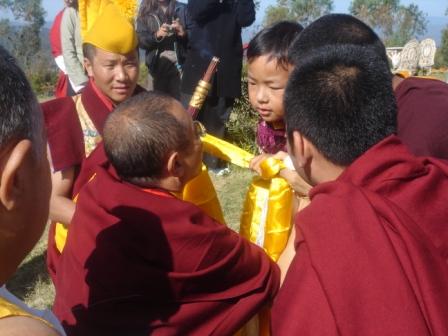
Tulku Urgyen Rinpoche has taken rebirth in the family of Neten Chokling Rinpoche and his beautiful wife, Tendzin Choyang Gyari.

Urgyen Jigmey Rabsel was born in the year of the snake & is 4 1/2 years old (6 Tibetan). He was born in the USA & has an American passport.

Kyabje Trulshik Rinpoche undeniably recognized him as the reincarnation of Tulku Urgyen Rinpoche after carefully investigating his experience while in strict retreat in the holy pilgrimage place in Maritika, Nepal.

The child is currently in Bir India with his parents & will be given a new name at the time of the hair cutting ceremony.

As an auspicious coincidence, Tulkus Chokyi Nyima, Tsikey Chokling, Tsoknyi & Phakchok Rinpoches as well as Tenpa Chophel will travel to Bir on March 3rd to meet the child and his parents. There will be a ceremony at the Neten Chokling Gonpa in Bir and with the sons of the former Neten Chokling Rinpoche, Urgyen Topgyal, Khyentse Yeshe, Jamyang & Dzigar Kongtrul Rinpoches.

This is a very happy time for all of the students of Tulku Urgyen Rinpoche. Please join together to pray for the further unfolding of auspicious circumstances in regards to this joyous event.

More information about the yangsi can be found on Tulku Urgyen's son Tsoknyi Rinpoche's website:
http://www.pundarika.org/tulku_urgyen_yangsi.htm

Wednesday, March 01, 2006

Sunday, February 19, 2006

Lord of Siddhas


This is the great master Shakya Shri, who was the root guru of Tulku Urgyen's Uncle Tersey. A full chapter is dedicated to this incredible yogi in Blazing Splendor. Here are the opening lines to give you a taste:

During his stay in Central Tibet, Uncle Tersey frequented the encampment of his root guru Shakya Shri, the great siddha-master. Shakya Shri was also known as the Lord of Siddhas and as Precious Realised Master. His main guru was Old Khyentse.
"Shakya Shri lived with about seven hundred disciples in Kyipuk," Uncle Tersey told me. "His disciples had dug caves all around the two surrounding slopes, while others stayed in tiny tents made of either canvas or yak felt. Shakya Shri himself lived on a meadow in the only house around, which was a simple structure of stamped mud with one large window."

A fine translation of Shakya Shri's biography together with some of his teachings and poems has been made by Elio Guarisco and we look forward to its eventual publication.

Thursday, February 09, 2006

A Path Strewn with Flowers and Bones

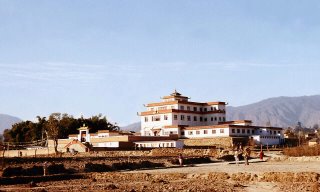
This picture of the construction of Chokyi Nyima's monastery, Ka-Nying Shedrub Ling, was taken by Lama Sherab in 1981. Lama Sherab also kindly provided the following story about his meeting Tulku Urgyen.

* * *

Kathmandu was still a city of quiet dirt roads, candle power, and open spaces in those days. The "modern" world had only started to intrude. One had to travel down to the central telegraph office to send a telegram, to the central post office or the American Express office to send or receive mail. Tulku Urgyen's new monastery, Ka Nying She Drub Ling, stood virtually alone outside the circle of buildings surrounding the Boudhanath stupa itself. [photo] A mimeographed sheet posted in the Bir Restaurant announced the first-ever seminar for foreigners to be offered in the monastery by Tulku Urgyen's eldest son, the abbott, Chokyi Nyima Rinpoche. I decided to attend.

The first day, Rinpoche spent several hours devilishly challenging the trekker, hippy and expatriate attendees to prove whether or not the table in front of him really existed. I was enthralled by his wakeful, playful manner and humor, and his impeccable logic. It was deconstruction on the fly, before I had ever heard that term or it became in vogue. I went back every day I could, and again on Saturdays.

** ** **

While I grew more and more keenly interested in Buddhist philosophy, and was touched by the devout spirit of the many Tibetans around me, I held firm to the notion that I was a free agent, an independent operator. I didn't want to join any guild or identify with any group. I scoffed when Chad Leech asked me whether I planned to take refuge. Why become a Buddhist? What were the perks and benefits? I could meditate without a membership card.

At the conclusion of Chokyi Nyima's seminar, the student group was to travel up to Nagi Gompa, a small speck visible far up the northernmost slope of the Kathmandu Valley, for a special instruction from Tulku Urgyen himself, whom CN referred to variously as "the boss" and "head office." CN also offered the opportunity and arranged for me to stay on for a while at Nagi after the teaching, for a private meditation retreat.

It was a rough hike indeed up to Nagi in those days, the last part a traverse up steep dirt trails. I watched Chokling Rinpoche, CN's younger brother, and a little portly, huff and puff his way up, with some generous support from below on his backside. The gompa (monastery) itself was just a small chapel in the middle of a clearing, without much light. After we had been sitting a while, Tulku Urgyen entered the shrine hall in response to the soulful, lilting chants of the resident nuns. He taught us to understand and perceive the nature of our minds, basing his remarks on the famous verse from the Buddhist canon:

Thus taught the Buddha:

Abstain from all harmful actions,

Practice magnificent virtue, and

Thoroughly train your own mind.

After the teaching, an endless stream of local pilgrims appeared from over the lip of the clearing to line up for a blessing from Tulku Urgyen, dressed in their finest holiday dresses and slacks. Before anyone in Kathmandu had telephones, everyone still knew where to be, and when.

Eventually, locals and foreigners alike began the trek home, back down into the valley, and I rolled my sleeping bag out onto the low bench in the back of the shrine hall on which the junior-most nuns sat during communal prayers, lit a candle, sat down, and began to practice as I had learned in my Insight meditation retreats.

After some days of "walking, walking," "breathing, breathing," and "thinking, thinking," and many hours gazing out from my perch on the flat ledge of a big cement ring girding the lone tree on the edge of the clearing, watching clouds unfurl over the valley, watching the simple herder cluck and chase after the few milk buffalo that served the gompa, the green shafts of barley wave in the breeze, I received, courtesy of a peculiar old Dutch woman who manifested in the shrine hall one day, a summons: "Tulku Urgyen says he will see you now."

"Please thank Tulku Urgyen for the offer, but I see no need to bother him. I have nothing to ask him, and am content to continue with my practice and retreat." Surprised by my answer, she beat a hasty retreat. The next day she appeared again, this time with more resolve. "You are to come see Tulku Urgyen now, you don't know what an unusual privilege it is to receive such an invitation." I demurred again, just barely.

The next day was the last of my scheduled stay. This time, there was no avoiding the call. Besides, what harm could there be in thanking Tulku Urgyen in person for allowing me to squat for ten days in the shrine, and take meals from his pair of young nun-chefs in a tiny back room, where they sniffed and wiped away tears as smoke billowed from the clay hearth stuffed with burning odds and ends of wood and yak dung?

I walked up the rickety, narrow staircase. The door opened before me. There across the room sat Tulku Urgyen in his meditation box next to a large picture window, waist wrapped in a simple blanket, more composed than I had ever thought it possible for anyone to be. He looked at me through his large glasses. I entered. I hardly noticed his student and translator, Erik Schmidt, sitting quietly by his side. "Do you have something to ask me?" Our eyes met, then I watched myself bow helplessly with uncontrived respect, struck to my very marrow by his presence, his calm, his mind enveloping the entire space and dissolving every last concept of self-importance I had carried into the room but a moment before.

With tears welling in my eyes and a slight tremor in my voice, I responded, "Yes, I wish to ask you to grant me the vows of refuge." We went through the ceremony together; Erik had to ask thrice whether the name was correct, verb and all -- Protected by the Three Jewels. Tulku Urgyen gave me ten rupees with a command to spend it all on my walk down the mountain, before I reached Boudhanath.

It was November 1981. My life had just completely changed. That old man in a blanket was the most genuine person I had ever met, by several orders of magnitude. I knew this the way I knew, one day earlier that spring as we returned from a Baha'i prayer meeting we had attended for our anthropology class, that I had fallen in love with Andrea Kozol -- only more so. Traipsing down the slopes with that ten rupee note burning a hole in my pocket, I was light as air, immensely glad to have made such a connection with Tulku Urgyen. I wanted to know what it was like to be him, wanted to be inside his mind, to learn everything he could possibly teach me. I cried thinking about what had just transpired, and vowed to follow every last word of advice he offered me.

(Excerpted from "A Path Strewn with Flowers and Bones," forthcoming. © 2006 Blazing Wisdom Institute, Inc. All rights reserved.)


Sunday, February 05, 2006

The Great Dakini of Tsurphu

This is a picture of the 15th Karmapa's consort, who was known as The Great Dakini of Tsurphu. Tulku Urgyen was greatly impressed by her and also taught her reincarnation Khandro Rinpoche who is the daughter of Minling Trichen who is the head of the Nyingma school. Khandro Rinpoche is also an amazing teacher, and having been raised and educated in India she teaches in English. You can read more about her, as well as check out her teaching schedule at her website.

Sunday, January 29, 2006

Tsechu Monastery and the Great Adeu Rinpoche


This is a picture of Tsechu Gompa in Nangchen. The abbot of Tsechu is a marvelous lama by the name of Adeu Rinpoche. Not only is Adeu Rinpoche one of the main holders of the Drukpa Kagyu lineage, but Tulku Urgyen used to "babysit" him when his teacher went to visit Tulku Urgyen's uncle Samten Gyatso. He talks about those early days in this interview.
You can learn more about Adeu Rinpoche at his website, where there are also lots more great photos.

Tuesday, January 17, 2006

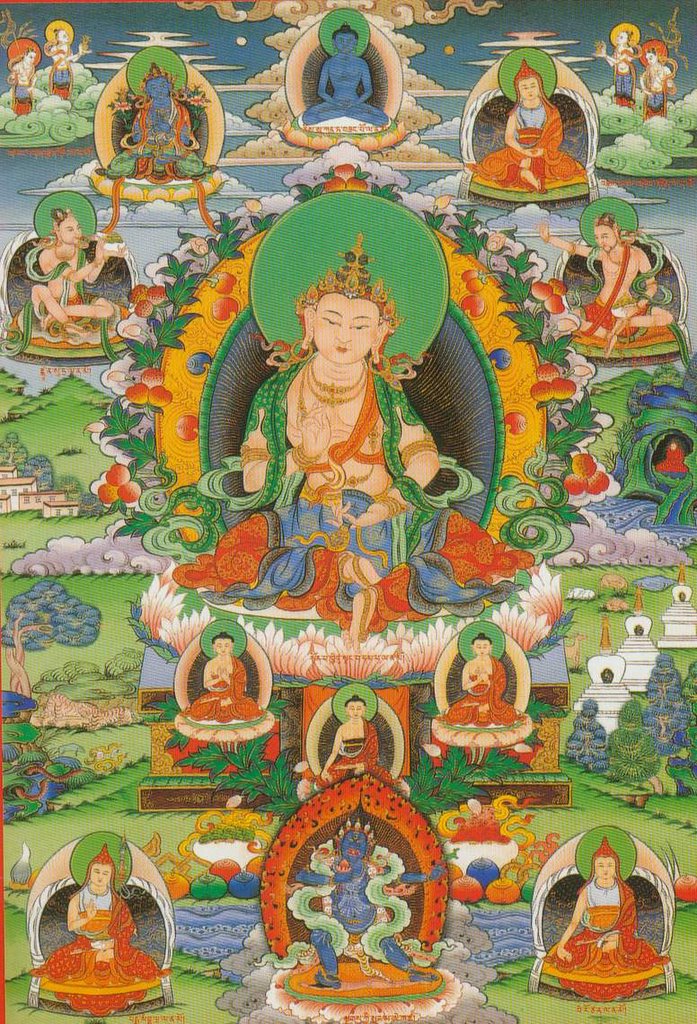
Youth of Inconceivable Sublime Light


The main teaching of the original teacher Buddha Samantabhadra is Dzogchen, the Great Perfection. The teachings of Dzogchen are the pinnacle of all nine vehicles. Before the Dzogchen teachings arrived in our human world, they were propagated through the Gyalwa Gong-gyü, the mind transmission of the victorious ones, in the three divine realms: first in Akanishtha, then in Tushita, and lastly in the Realm of the 33 Gods, the world of Indra and his 32 vassal kings located on the summit of Mount Sumeru.
Generally, it is said that the 6,400,000 Dzogchen teachings entered this world via Garab Dorje, the first human vidyadhara, who directly received the transmission from the Buddha in the form of Vajrasattva. These teachings first arrived in Uddiyana, and later were propagated in India and Tibet. Before the era of Buddha Shakyamuni the Dzogchen teachings were propagated in our part of the universe by other buddhas known as the Twelve Dzogchen Teachers. Buddha Shakyamuni is usually counted as the fourth guide in this Excellent Aeon in which one thousand fully enlightened buddhas are to appear in our world. Although in this context he is known as the fourth guide, Shakyamuni is the twelfth in the line of Dzogchen teachers.
No Dzogchen teachings have occurred apart from the appearance of a buddha in this world, so we must count Buddha Shakyamuni as one of the chief teachers through whom the teachings were transmitted. He did, indeed, convey Dzogchen teachings, though not in the conventional manner. His conventional teachings were primarily received by those who had a karmic connection with the teachings appropriate to shravakas, pratyekabuddhas and bodhisattvas. It was not that they were not allowed to receive the Dzogchen teachings; their karmic fortune was such that they received the teachings to which they were suited. The Buddha gave Dzogchen teachings, as well as other Vajrayana instructions, by first manifesting the mandala of a deity and then imparting the tantric teachings to a retinue seated within that setting. This, however, does not lie within the scope of what was perceived by ordinary people.
--Tulku Urgyen Rinpoche

The Tangkha is depicting Youth of Inconceivable Sublime Light (khye’u snang dam pa bsam gyis mi khyab pa) one of the first of these Twelve Dzogchen Buddhas. Shakyamuni is the Twelfth. The painting was supervised by Nyoshul Khen Rinpoche shortly before his passing.

Monday, January 16, 2006

Longchenpa's likeness


My guru, Samten Gyatso, also had a deep fondness for the masters Longchenpa and Jigmey Lingpa. He would often read aloud from Longchenpa’s Seven Treasuries, not as a formal reading transmission but just for himself—slowly and in a gentle tone of voice. He always carried one of these seven volumes with him wherever he went, so that by the end of the year he would complete his reading of all seven. After some years, he knew exactly where to find every single detail mentioned anywhere in these Treasuries. He would sometimes comment, “How wonderful! What an amazing master Longchenpa must have been! How profound his words are!” -- from Blazing Splendor.

The picture is of an old statue made at the time of Longchenpa himself. The recent Dzogchen master Nyoshul Khen Rinpoche treasured this image highly and had it reproduced innumerable times. One of his main attendants and students, Khenpo Sonam Tobgyal Rinpoche, who now heads Riwoche Temple in Canada, made many of these with his own hands.

Saturday, January 14, 2006

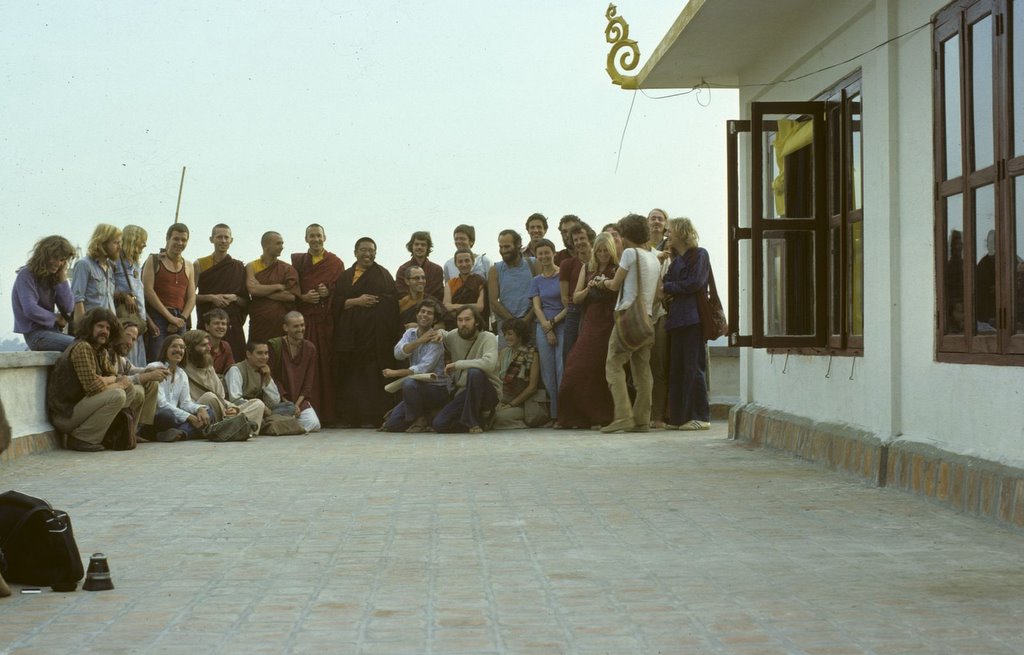
On the roof of Ka-Nying Gompa in 1976


The place is Ka-Nying Shedrub Ling monastery. The occasion is the Sixteenth Karmapa who has come to Boudha to inaugurate Tulku Urgyen Rinpoche's and Chokyi Nyima Rinpoche's new gompa and confer the Treasury of Kagyu Teachings. Here is Khenchen Thrangu Rinpoche flanked by a sundry assembly of ordained monks and bearded ngakpas, 30 in all. Let's hear some names !
Matthew Kapstein & Edward Henning (who sent this picture) sit right below the british monk Lodro Thaye. Please let us know if you recognize anyone else.

Saturday, January 07, 2006

The great siddha Shakya Shri's sons repair the Boudha Stupa

In the Early part of the 20th century the great siddha Shakya Shri sent his sons to restore the great stupa of Boudhanath. Here is a rare photo taken at the occasion. Another restoration, which took place half a century later, is captured on this page: http://blazing-splendor.blogspot.com/2005/11/tashi-who-becomes-shechen-rabjam.html

Tuesday, January 03, 2006

"Blazing Splendor" Reading at Karma Triyana DharmachakraWoodstock, NY, Feb 4, 2006 at 2 pm

Tulku Urgyen Rinpoche was among the greatest masters of the Kagyu lineage of the twentieth century, and pivotal in bringing the highest Buddhist teachings to the West. His memoirs, "Blazing Splendor," offer an intimate glimpse into the extraordinary lives and experience of recent great masters of meditation in Tibet, including the great Treasure Master Chogyur Lingpa and his vajra brothers Jamyang Khyentse Wangpo and Jamgon Kongtrul Lodro Thaye, Mipham Rinpoche, Patrul Rinpoche, and many others.
In particular, as principal holder of the Chogling Treasure lineage, which was extremely famous and widespread in Eastern Tibet before the Communist invasion, Tulku Urgyen was close to the 15th Karmapa, Kakhyab Dorje, and was a personal guru and advisor to the 16th Karmapa, Rangjung Rigpa'i Dorje, for many years at Tsurphu Monastery and in exile, accompanying him on his first visit to KTD more than twenty-five years ago.
As we approach the 10th anniversary of the miraculous passing of Tulku Urgyen Rinpoche, the authors of Blazing Splendor have requested a small number of his close students to host commemorative readings of excerpts from Blazing Splendor to celebrate his life and his activities on behalf of our precious practice lineage.
KTD will host a reading by Lama Sherab Dorje on February 4, 2006 at 2 pm. Lama Sherab will read passages from the book that are of special import to the monastery and its lineage, as well as share personal stories and anecdotes about Tulku Urgyen and other great masters, and tell of his recent pilgrimmage to the vulture fortress retreat center atop Tsurphu monastery in Tibet.
Lama Sherab's special guest will be Heinz Insu Fenkl, Director of the Creative Writing Program at SUNY New Paltz, who will read excerpts from his forthcoming novel about the Buddha's life based on the sutras, entitled "Siddhartha Gautama." Heinz was a Pen/Hemingway awards finalist in 1996 for his novel, Memories of my Ghost Brother, soon to be reissued by Bo Leaf Press.
All are welcome and there is no charge for this event. Nonetheless, advance registration is strongly recommended. Please use the following contact information, and be sure to indicate that you are coming for the reading event.
You may also want to drop us an email to let us know that you will be there. Bardor Rinpoche is also teaching at KTD that weekend, and you may register for and attend that program as well. Ask KTD for further information.

Contact:
Thomas C. Schmidt /External Affairs Officer / Karma Triyana Dharmachakra
335 Meads Mountain Road
Woodstock, NY 12498 USA
PH: 845.679.5906 ext. 15 Fax: 845.679.4625
external.affairs@kagyu.org
http://www.kagyu.org
http://www.karmapa.net