Thursday, September 22, 2011
Freedom in Bondage
Saturday, September 17, 2011
last days
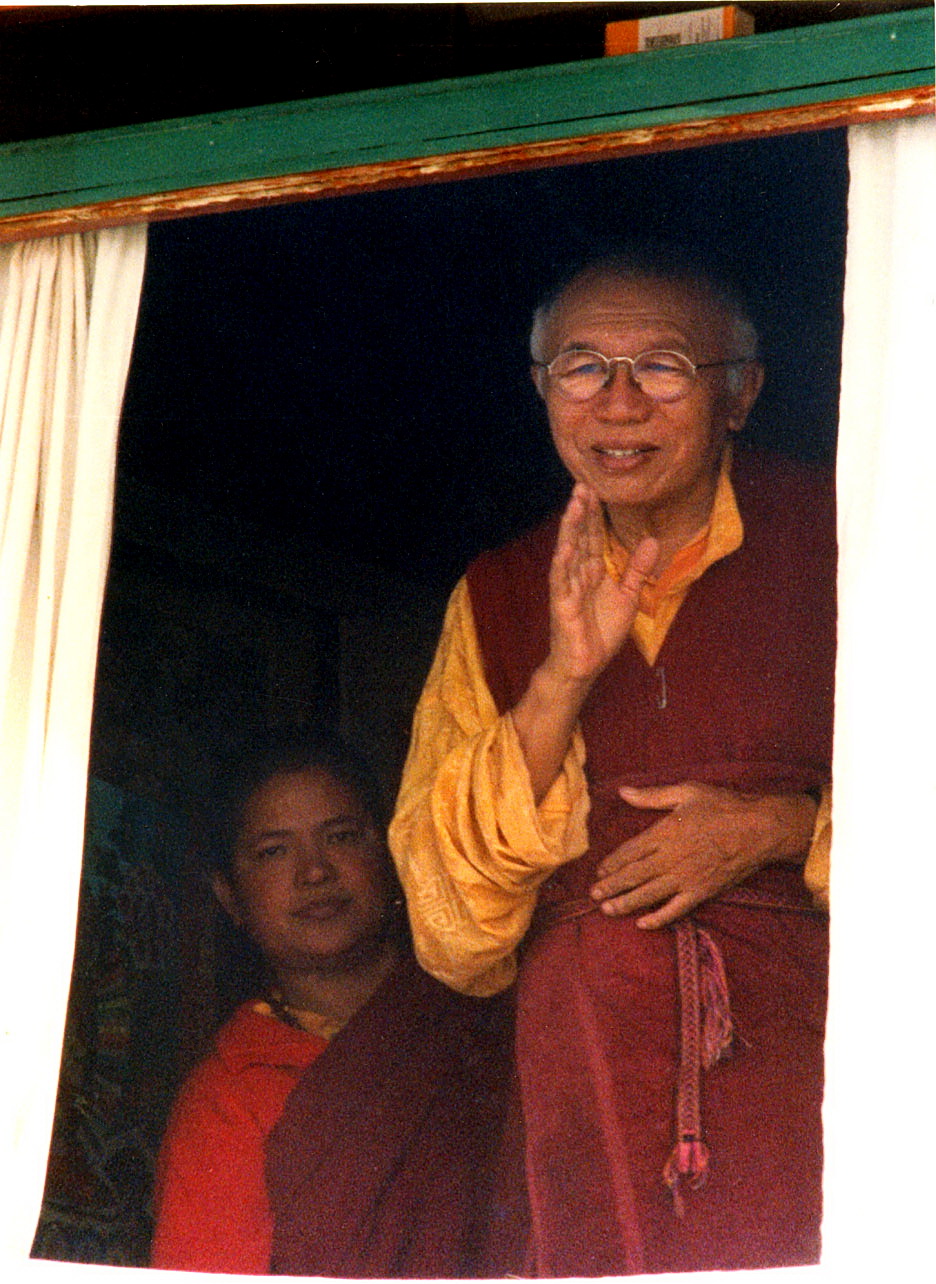
waving from the window of his room at Nagi Gompa in 1996.
With him is his attendant Dondrub Tara.
Sunday, October 10, 2010
Bomta Khenpo
He continued after a pause, "I'm an old man now and I tell you this without bragging, but this old man here is a bearer of the authentic Dzogchen teachings. Still, what good does that do? No one comes here to request them and even when they do, they rarely understand. A lecturer without an audience is no more than a barking dog. What's the use of me teaching into the air?
"No one from Kham, Central Tibet or these southern mountain ranges has come to request the view with a sincerity coming from the core of their heart. My health is now failing, yet I am still the old bearer of the true Dzogchen teachings--and it seems that I am going to take them with me when I die."
It stung me to hear these moving words, so I requested as many teachings as I could.
from Blazing Splendor, pg. 348
Tuesday, June 15, 2010
Gebchak meets Google
Wangdrak Rinpoche of Gebchak Gompa, and Caterina De Re give a presentation about the Gebchak Nunnery at Google's headquarters in San Francisco.
Sunday, May 16, 2010
Bringing Buddhism to the West
Question: The question always seems to come back to the same thing, which is how an ancient tradition, which grew up in a certain cultural environment and comes from a background entirely different from our modern world can come into the modern world, with all the forces at work here that are so different from—and even against—the spiritual search. What adjustments need to be made and how do you see the particular problem of modern people? Modern civilization with its technology and economic situation has created an entirely different atmosphere than the tradition that you grew up in. What do you see as the specific first steps that need to be taken for us, for modern people?
Answer: It is very true that the whole of our world is becoming modernized. However, we have also to understand that Buddhism first developed in India and adapted itself to the cultural tradition there. And later, when Buddhism was brought into Tibet from India, it also had to adapt itself to the Tibetan tradition. But the essential Buddhist teaching has remained very much unchanged. The essential quality of Buddhism and the meditation practices never really changed in going from one country to another.
So, therefore, Buddhism emphasizes two aspects of the teaching: the “view” aspect, and the “practice” or “meditational” aspect. The “view” aspect of Buddhism teaches the ultimate nature of outer phenomena and the ultimate nature of ourselves. That ultimate nature never changes, whether considering ancient times, a thousand years ago, or the modern era. So Buddhism speaks philosophically about the ultimate nature of external and internal being, and about that ultimate nature remaining unchanged.
Therefore, what is made available to the new generation of the Western world is that very essential, or ultimate, part of Buddhism, which is called the Dharma. And again, speaking from experience, if the Dharma were false or if the new practitioners in the West had to adopt a Buddhism which included the Tibetan culture, then it would become conflicting and could create considerable misunderstanding and confusion in the minds of the beginning practitioners. This has been the case since ancient tunes.
So what seems proper is for the Western mind to adopt the essential nature of Buddhism, the Dharma, and not necessarily the cultural aspects. And it seems important for all of us to maintain a responsibility not to mix the Dharma with a culture or tradition.
One must not look at the Dharma as belonging to somebody or some nation; if one does so, this can be the beginning of the greatest confusion. So Rinpoche believes that the Dharma can be adapted to any culture, but one cannot make the Dharma into a culture.
read more
Monday, March 22, 2010
Rare footage of Dilgo Khyentse and Tulku Urgyen together
This video contains wonderful footage of Tulku Urgyen visiting Dilgo Khyentse Rinpoche for the last time. Lots of familiar faces including Tulku Urgyen's sons Chokyi Nyima Rp. and Tsoknyi Rp., as well as his close disciple Andreas Kretschmar. Footage begins around the 2:30 mark.
Our thanks to the anonymous person who shared the link.
Wednesday, July 01, 2009
Great Yogini
We crowded into the small dark room and sat shoulder to shoulder. The ceiling was covered with years of soot so thick that black stalactites had formed. My eyes teared from the fumes of incense and the yak dung smoke leaking from a crude wood stove. In the dark corner, light spilled from the doorway illuminating an ancient face, deeply etched from the harsh Tibetan life at 14,000 feet. There, leaning back in her meditation box was Sherab Zangmo spinning her prayer wheel.
When Sherab Zangmo was a young nun, during a dark retreat (a Dzogchen practice of staying in total darkness for 49 days and nights), she had a vision of Yeshe Sogyal, Padmasambhava’s principle consort.
“Three times she offered me mudras (hand gestures) and then she became Tsang Yang Gyamtso (the student of the first Tsoknyi Rinpoche who started Getchak Nunnery). He came to rest on top of my head and then he dissolved into my body, speech and mind. We became one. I cried and cried. That moment I had a direct experience of the nature of my mind. I have had many experiences, good and bad, but my mind has remained stable, neither good nor bad.”
read on...Monday, March 09, 2009
mandala offerings
Wednesday, February 11, 2009
Finding a Quiet Space

[NYTimes] AS dusk rolls in from the distant Himalayas, I nervously dart into the chaos of vehicles roaring up and down Boudha Tusal, my eyes fixed on the ornately carved stone gateway across the boulevard.
Dodging a swarm of buzzing mopeds, I duck past a taxi blasting subcontinental pop music and scoot across the path of a truck whose cab is painted with images of the long-haired Shiva and the elephant-headed Ganesh, Nepal’s ubiquitous Hindu gods. The haze of exhaust fumes rivals any Scottish mist. Traffic cops shout in Nepali as I jump onto the curb and speed between the two stone snow lions guarding the tall arch.
Suddenly, as if I have entered another world, the toxic fog dissipates and gives way to the sweet odor of burning juniper incense. Vanished, too, are Shiva, Ganesh and their Hindu brethren. Instead, the enormous disembodied eyes of the avatar of a different faith — Shakyamuni, better known as the Buddha, peer down from a soaring multitiered stupa, or temple. The Nepali pop songs fade, replaced by chanting .
“Om mani padme hum,” comes the ancient six-syllable refrain, repeated by groups of Tibetan monks in oxblood robes. “Hail to the jewel in the lotus.” (read full article)Sunday, February 08, 2009
Blessings
Friday, February 06, 2009
Naked Awareness
Tuesday, November 04, 2008
Juniper Ridge now available

Treasures from Juniper Ridge is a collection of “hidden” or terma teachings given by Padmasambhava, the Tantric master who brought Vajrayana Buddhism to Tibet. According to Tulku Urgyen Rinpoche, Padmasambhava hid many teachings to be uncovered later by “revealers of hidden treasures.” The special quality of the terma teachings is that they provide guidance appropriate for each period of time and individual person. By working with Padmasambhava, Yeshe Tsogyal, his mystic spiritual consort, was able to compile and codify these precious insights and hide them for use by future generations.
Treasures from Juniper Ridge presents a variety of significant revelations for seekers on the advanced path of the Tibetan Vajrayana tradition, as well as in-depth explanations of assorted aspects of practice: deity-focused meditation, nonconceptual meditation, death and dying, and recognizing the nature of mind. The book outlines ways for the modern student to apply these teachings while remaining true to Vajrayana Buddhism’s traditional principles.
Available now at an independent bookstore near you
or online at Amazon.ca or Amazon.com
Sunday, October 19, 2008
Dharma Sun

For those of you who do not have the good fortune to regularly attend Chökyi Nyima Rinpoche's famous Saturday talks at Ka-Nying Shedrup Ling in Nepal, Dharma Sun makes recordings available on a regular basis. This website emerged from Chökyi Nyima Rinpoche's wish to make the Buddha's teachings available to everyone. Highly recommended!
Tuesday, September 02, 2008
Buddhist prayer services for anyone who needs help

Buddhist prayer services for anyone who needs help. Buddhist prayers on this website http://monlam.org/mainprayers.html are offered frequently. These prayers can done for you or your family very soon. Most of the prayers are performed by the monks of Ka-Nying Shedrub Ling. Tara Praises and Chöd are done by the nuns of Nagi Gompa.
Monlam means "wish-path" - the Buddhist path of helping others through kind prayers. Monlam.org is a service of Ka-Nying Shedrub Ling, a Buddhist monastery in Kathmandu, Nepal; and Nagi Gompa, a Buddhist nunnery on Shivapuri Mountain near Kathmandu.
Through this site you can request Buddhist prayers for yourself and others. Your donations help support the monks and nuns who perform the prayers. Some of the monastics are Tibetan refugees. All money raised goes to the monastery and nunnery, except for the small costs of having a website and using Paypal. Prayers and pujas are supervised by Chokyi Nyima Rinpoche and Chokling Rinpoche, accomplished teachers of meditation and ritual.
People in Buddhist cultures have relied on the prayers of monks and nuns for centuries. Full-time spiritual practitioners develop deep wisdom and great kindness, which make their prayers especially effective. Sacred rituals, originated by highly realized masters, enhance the blessing power of the prayers.
Pujas are beautiful and powerful. Body, speech, and mind are all involved. Prayers and pujas can involve reciting sutras, chanting mantras, performing mudras, visualizing Buddhas and Bodhisattvas, and offering water, flowers, incense, lights, food, music, etc. All these methods generate merit. Merit is necessary for health, long life, happiness, and spiritual realization.
Anyone who needs help can request prayers. You don't have to be a Buddhist. You can ask for prayers for healing, long life, prosperity, support for the dying and the dead, etc.
We ask that you donate to support the monks and nuns. Buddhist prayers, teachings and rituals are traditionally given without a price tag. Monks and nuns pray for people without asking for anything in return. Buddhist lay-people donate as generously as they are able. Many people are unfamiliar with this culture of mutual giving, so donation amounts are listed for each service. Giving creates merit. Merit is essential for happiness, good health, long life, worldly success, spiritual realization and good rebirth.
Thursday, April 17, 2008
Tulku Urgyen's reincarnation with our editor
As you may know, the tulku and his parents will be invited from Bir in nortern India to Ka-Nying Shedrub Ling in Nepal for the grand enthronement ceremony this coming November.
Saturday, November 10, 2007
Milarepa the Movie--screenings in Canada

Neten Chokling's directorial debut--Milarepa--is screening in Canada over the coming weeks.
NOVEMBER 30 - DECEMBER 7
The Fifth Avenue Cinemas VANCOUVER, BC
DECEMBER 7
BYTOWNE CINEMA, OTTAWA, ON
and
EMPIRE 17 CINEMAS, BAYERS LAKE, HALIFAX
DECEMBER 14th
METRO CINEMA, CITADEL THEATER. EDMONTON. AB
DECEMBER 15th
PRINCESS CINEMA. WATERLOO, ON
DECEMBER 16th, 18th, 19th
BLOOR CINEMA. TORONTO, ON
more info, including purchasing tickets, can be found at the offical website.
Tuesday, September 11, 2007
Journey to Nangchen

For those of you with a good internet connection here is a marvelous video of a visit Tsoknyi Rinpoche made to his nunnery in Nangchen: Journey to Nanchen. Enjoy!